Someone texts at 5pm saying they can’t make it. The session is in two hours. What do you do?
The wrong call here causes more drama than the missed session itself. The right call is one your group agreed on before it happened — not one you’re improvising while everyone waits in the group chat.
Here are your options, when each one works, and how to stop this from being a crisis every time.
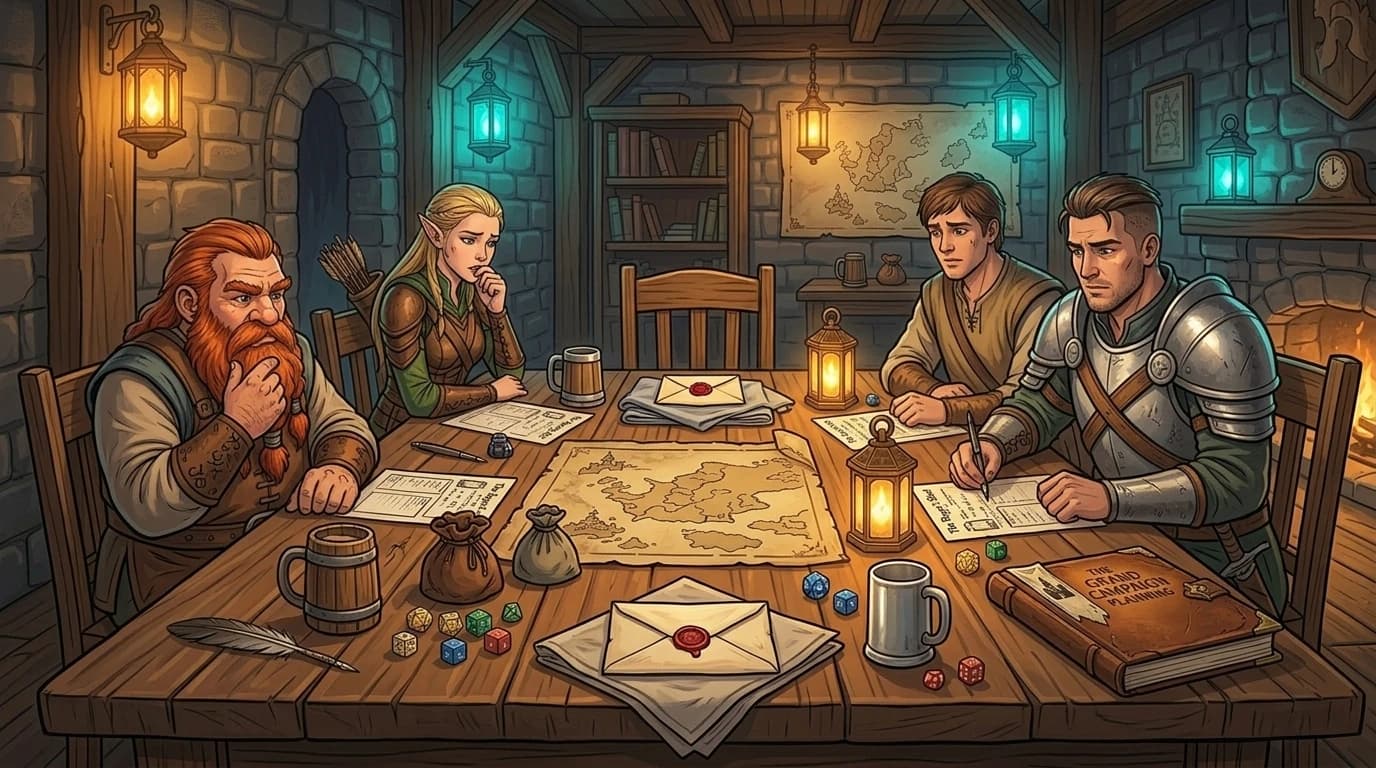
First: Decide whether to run at all
Before you worry about what to do with the absent character, answer the threshold question: does this session happen at all?
Run Anyway When…
- You have a quorum. If the group agreed on a minimum player count and you’re above it, the decision is already made.
- The session is mid-arc. Cancellation loses momentum. If you’re deep in a dungeon or mid-heist, pausing for a week costs more than playing without one person.
- The absent character isn’t central to tonight’s plot. If the rogue is missing and tonight is a diplomatic negotiation, you probably won’t notice.
- Players have travelled or prepped specifically for tonight. Respect the people who showed up.
Cancel or Reschedule When…
- You’re below quorum. No debate needed. The group already agreed on the number.
- The absent character is load-bearing. If the paladin’s oath is the reason you’re in this dungeon, running without the paladin’s player is a waste of a good scene.
- Multiple players are absent. One absence is logistics. Two or more is a sign tonight isn’t the night.
- You’re at a major story beat. Some moments deserve the full party. Save it.
The four ways to handle an absent character
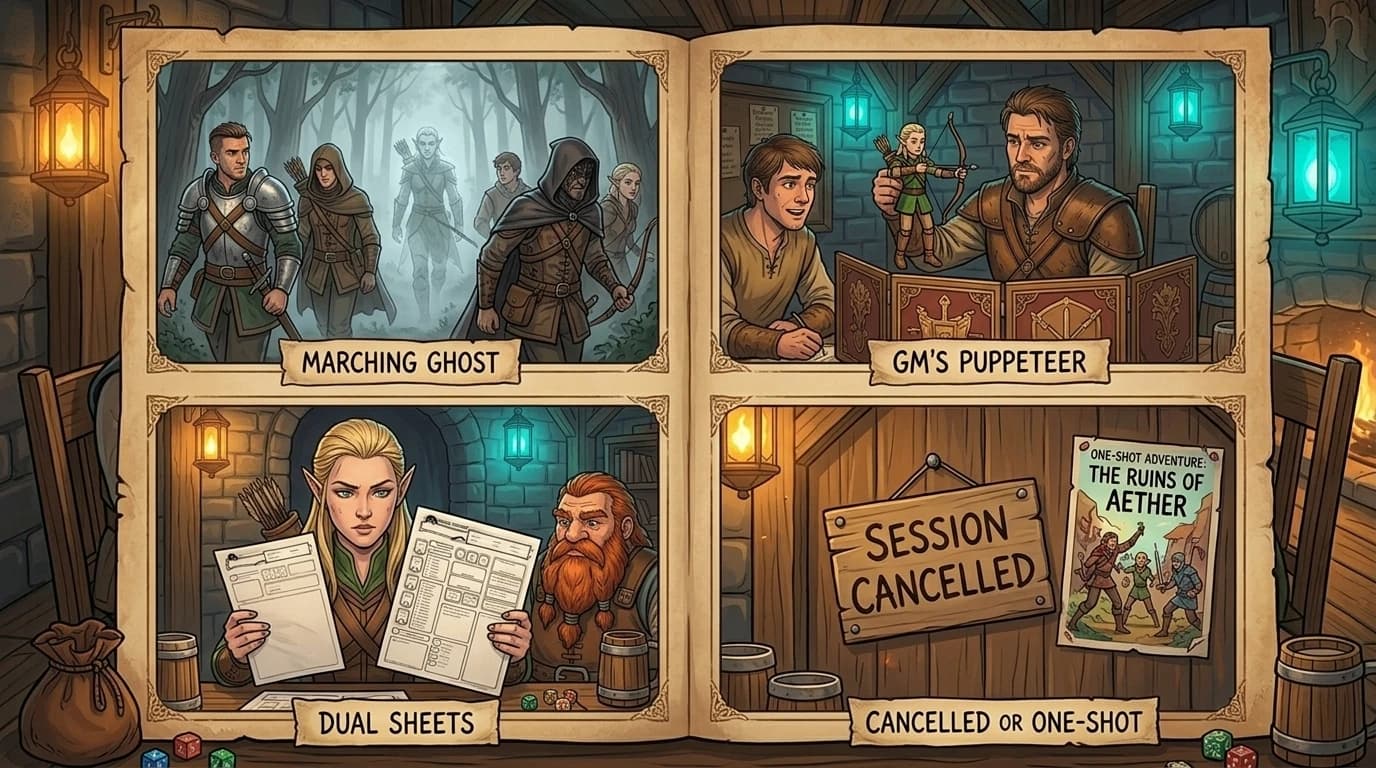
1. Fade Out
The character is physically present but inactive — “resting,” “scouting ahead,” or simply not in the scene. No one controls them. They don’t speak, fight, or make decisions.
- Best for: low-stakes sessions, downtime, social encounters, exploration.
- Avoid when: the character would obviously be central to combat or a key decision. A faded-out fighter standing silently while the party is ambushed strains belief.
- The upside: it’s the lowest-friction option. The fictional excuse doesn’t need to be elaborate — players accept it gracefully.
2. GM Pilots the Character
You play the absent character at a minimal level. They move with the party. They take basic actions in combat. They don’t make major story decisions, deliver dramatic monologues, or do anything the player would hate.
- Best for: combat-heavy sessions where a missing party member creates a balance problem. Down a healer or a tank? Running the character on autopilot keeps the encounter from becoming a grind.
- The golden rule: the absent player should return to a character in roughly the same state they left. Same HP, same spell slots (roughly), same relationships. No surprises.
3. Another Player Pilots
A trusted player runs the absent character for the session. This works in groups with high trust and compatible play styles — and only with the absent player’s explicit agreement. Not “I’ll just run them,” but “hey, are you okay with Sarah handling your character tonight?”
- Best for: groups where players know each other’s characters well and can resist the temptation to play them “their way.”
- The risk: players imprint their own style on someone else’s character. The quiet cleric suddenly cracks jokes. The cautious wizard charges into melee. Feelings get hurt when the absent player hears the recap.
4. Cancel or Pivot
Cancel the main session and run something different instead. A one-shot. A flashback scene. A side quest for the characters who are present. An arena battle royale. A heist that happens “off-camera” from the main plot.
- Best for: major absences (two or more players), pivotal story moments, or sessions where running the main plot without the absent character makes no narrative sense.
- The one-shot pivot is underrated. It keeps your group in the habit of showing up on game night, gives you a break from campaign prep, and lets players try weird character concepts they’d never commit to for a full campaign.
If you do reschedule, finding a new slot shouldn’t take a week of group-chat negotiations. Roll4Availability shows everyone’s availability in one place — pick the next open slot and move on.
Setting an absence policy at Session Zero
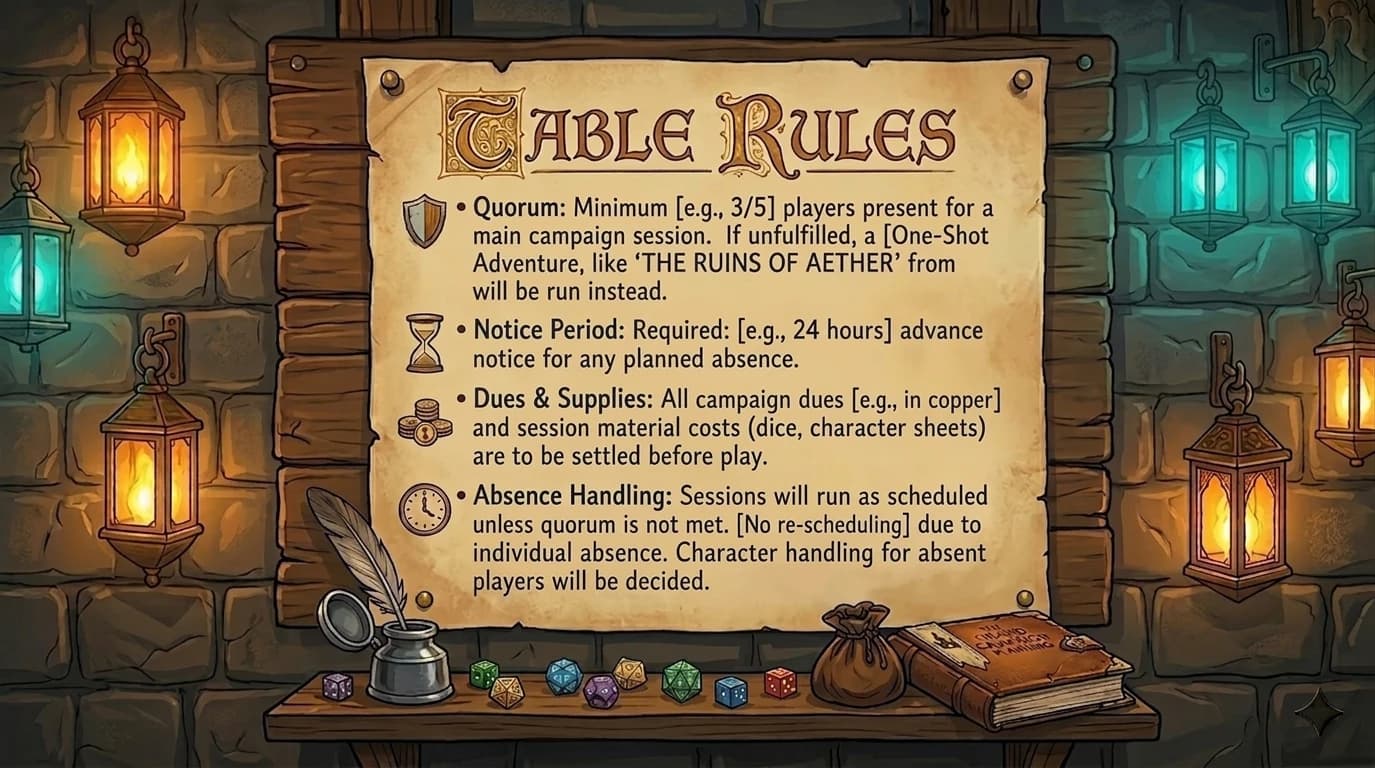
The cleanest solution is to have this conversation before the first campaign session — not when someone’s already texted at 5pm. If you covered this in your Session Zero, you’re ahead of most groups. If you didn’t, it’s not too late.
Things to agree on:
- Notice period. How much warning counts as “good notice”? Twenty-four hours? Forty-eight? A week? Set a number so nobody has to guess.
- Quorum. How many players do you need to run? Three of five is common. Pick a number and stick to it. (See our scheduling frequency guide for more on quorum.)
- Default handling. Do you fade out, NPC, or cancel by default? Having a default means you don’t re-litigate the decision every time.
- Repeated absence policy. What happens if someone misses three sessions in a row? Agree on this before it becomes personal.
- Major plot moment rule. Some groups agree that pivotal scenes wait for the full party. If that’s your table, say so upfront.
Document it. Shared Google Doc, Discord pin, wherever your group keeps notes. “We agreed on this” is a much easier conversation than “you should have known.”
The harder problem: Chronic absenteeism
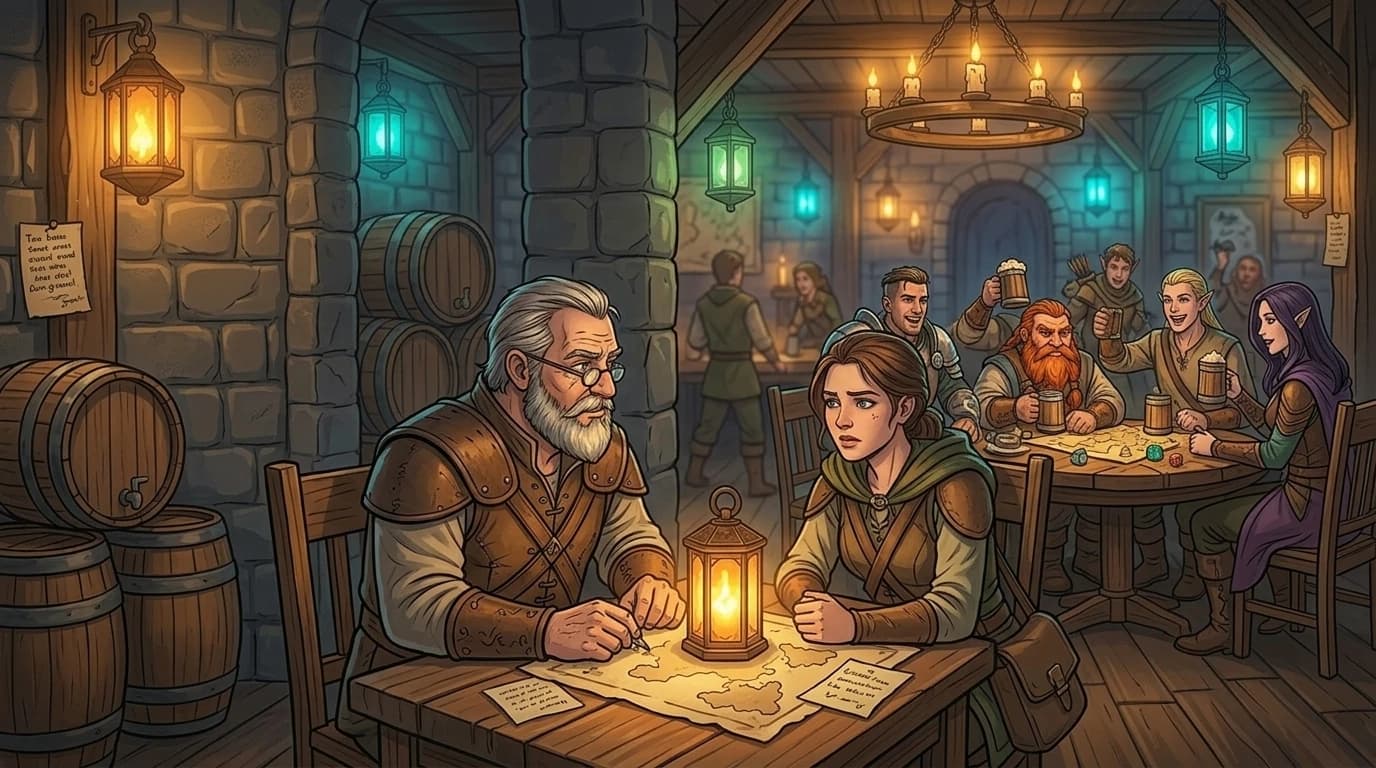
One missed session is logistics. Repeated absences are a different issue entirely.
- Have the conversation privately. Before it becomes a group issue, talk to the player one-on-one. A DM to the absent player, not a callout in the group chat.
- Ask whether their schedule has genuinely changed. Maybe Tuesday doesn’t work anymore. Maybe they picked up a new shift. The fix might be as simple as moving the slot.
- Consider whether they still want to play. Sometimes people don’t want to say no directly. They stop showing up instead. Giving them a graceful exit (“no hard feelings if life has changed”) is kinder than letting the awkwardness build.
- Revisit the campaign schedule. If one player consistently can’t make Tuesday, Tuesday might be the wrong night. The group’s needs have changed — the schedule should change with them.
The Short Version
Set a quorum policy at Session Zero
Saves the “do we run tonight?” argument every time
Fade out works for most low-stakes sessions
Simple, low friction, no one needs to pilot a second character
GM pilots the character for combat-heavy sessions
Keep it minimal — don’t do anything the player would hate
Pivot to a one-shot when key players are absent
Keeps the session alive without forcing the story forward awkwardly
Agree on an absence policy before anyone misses a session
Much easier to enforce when it’s pre-agreed, not improvised
Chronic absence is a conversation, not a scheduling problem
Address it directly and privately — before it poisons the table
The table exists for the players who show up. Make it easy for them.