Everyone wants to play more than they actually manage to. Weekly sounds ideal. Monthly feels like failure. The reality is messier than either.
The right answer isn’t a number — it’s whatever your group can sustain without resentment. An ambitious schedule that collapses after three sessions does more damage than a modest one that quietly runs for two years.
Here’s how to figure out what actually works for your table.
The three main schedules (and who they’re actually for)
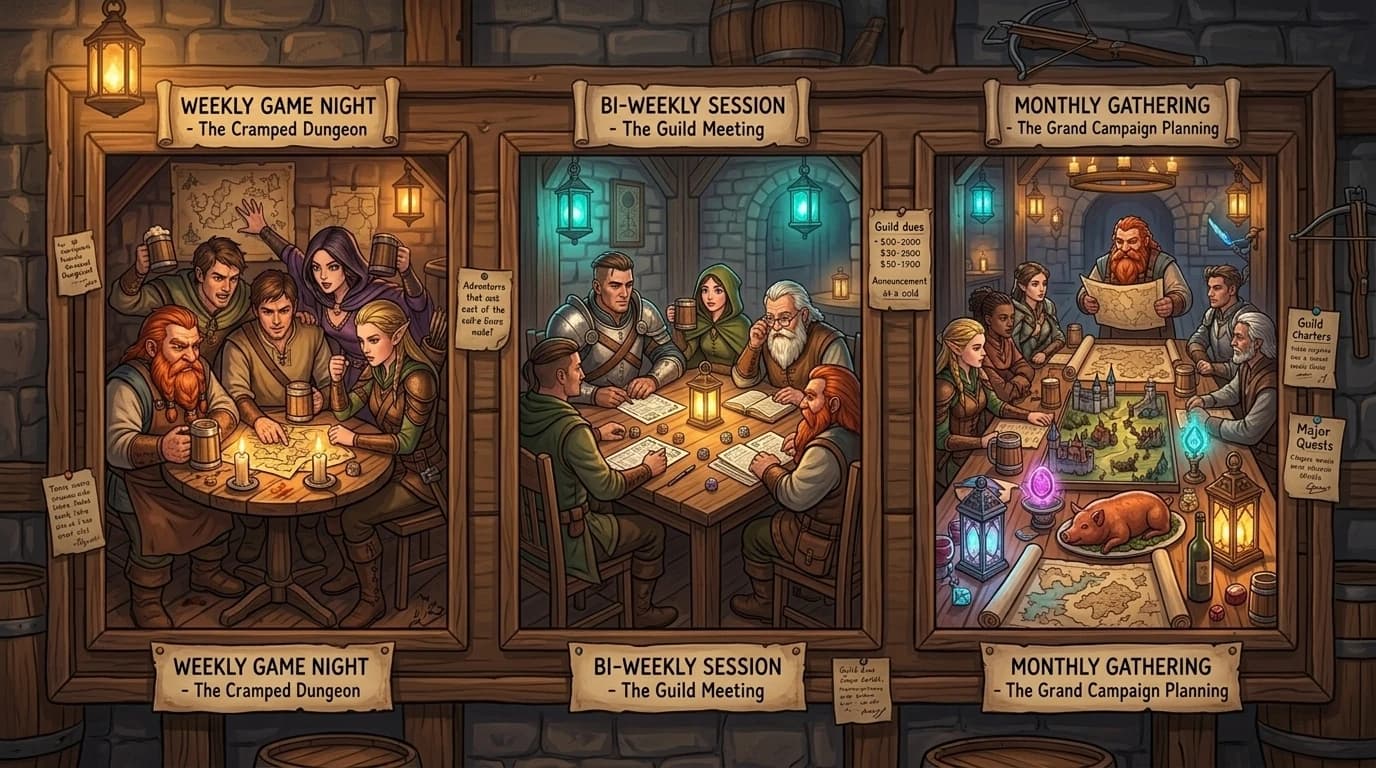
Weekly
Weekly is the gold standard for narrative momentum. Your players remember what happened last session. Plot threads stay taut. Characters develop at a pace that feels natural, not lurching.
It works best for groups with flexible schedules — students, remote workers, or anyone without a packed evening calendar. If your whole group can genuinely commit to the same night every week, this is the dream.
The risk: one person’s schedule change kills the whole cadence. Weekly sounds great at session one. It’s the hardest frequency to maintain.
Bi-Weekly (Every Two Weeks)
The sweet spot for most adult groups. Long enough to prep properly. Frequent enough to retain momentum. One missed session doesn’t derail the whole campaign.
Here’s the practical argument: if you aim for weekly and miss one in three, you’re already playing bi-weekly — you just feel worse about it. Better to set the expectation honestly and hit it consistently than to chase a weekly cadence that breeds guilt every time someone cancels.
Monthly
Monthly works for groups that have genuinely accepted infrequency. It’s not failure — it’s a different kind of game.
You’ll need more recapping at the start of each session. Long-form narratives struggle because players forget the details between sessions. But one-shots, anthology-style campaigns, and episodic formats work beautifully at this pace.
The GM does carry a heavier prep burden — you need to re-engage players who’ve had four weeks of real life since the last session. A written recap sent a day or two before game night goes a long way.
What actually determines the right frequency
Player count and life stage
Four players in their twenties sharing a city is a completely different scheduling problem from five players in their thirties and forties with kids, careers, and commutes. More players means more scheduling conflicts, which pushes you toward lower frequency whether you like it or not. Three players who can reliably meet weekly will play more D&D in a year than six players who aim for weekly and manage it twice a month.
Session Length
A two-hour session every week and a four-hour session every two weeks give you roughly the same play time per month. They just feel different.
Shorter sessions suit groups with tight evening windows — kids’ bedtimes, early starts, weeknight fatigue. Longer sessions let you reach the satisfying climax of a dungeon or arc in one sitting. Frequency and session length are two levers. Adjust them together.
Campaign Type
- Long campaigns (6+ months) benefit from higher frequency to maintain story investment. If your players can’t remember the NPC they made a deal with last session, the narrative frays.
- One-shots and short arcs can run monthly without losing the thread. Each session is self-contained or close to it.
- Episodic or anthology formats are the most forgiving of gaps. Think “monster of the week” — each session stands on its own, so a month between them doesn’t cost you anything.
The Quorum Question
How many players do you need for a session to run? This is the question that separates groups that play regularly from groups that are always “rescheduling.” If you haven’t agreed on this yet, it belongs in your Session Zero checklist.
A group of five that requires all five to play is one absence away from cancellation every single week. Set a quorum of three or four and sessions run even when life intervenes. The absent player’s character fades into the background for a session. The campaign survives.
What is a quorum?
In TTRPG terms, a quorum is the minimum number of players needed to run a session. Most groups set it at one fewer than their full roster — so a five-player group runs with four. Some groups go lower. The key is agreeing on the number before someone cancels, so there’s no awkward negotiation every time.
The scheduling problem nobody talks about
The frequency question assumes you’ve already solved the harder problem: knowing when everyone is actually free.
Most groups waste more time negotiating when to play than they spend actually playing. You know the pattern. Someone posts “when does everyone work?” in the group chat. Six contradictory replies arrive over three days. A session gets booked. One person cancels. The whole thing gets rescheduled. Repeat until the campaign quietly dies.
The fix is to collect everyone’s real availability once and find the overlap, rather than renegotiating every week. Roll4Availability does exactly this — each player marks their weekly availability, and you can see at a glance where the group overlaps. Find your recurring slot once. Stop polling the group chat. (If you’re currently doing this with When2Meet or Doodle, here’s how the tools compare.)
How to pick your frequency
Knowing the options is one thing. Making the decision is another. Here’s a framework that takes five minutes.
Ask everyone to mark their genuine availability
Not aspirational availability. Real availability. The evenings they’re actually free, not the ones they wish they were.
Find your overlap
How many shared slots does the group have per fortnight? This is your ceiling.
Choose the slot with the most overlap, not the most ambition
Weekly sounds great. Bi-weekly you’ll actually do.
Set a quorum
Agree in advance how many players you need to run. Write it down.
Book the next session before the last one ends
This single habit does more for campaign longevity than any scheduling tool.
When to Change Frequency
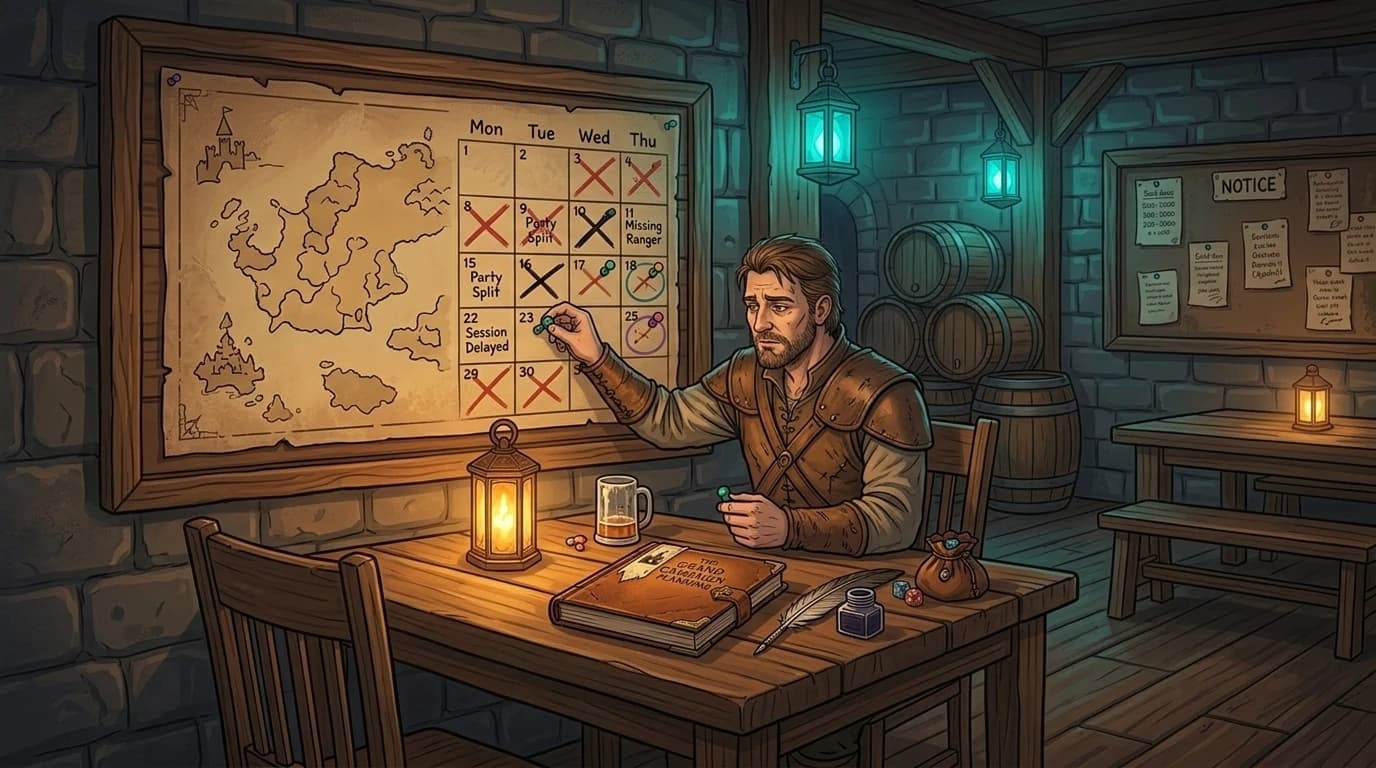
Your schedule isn’t a permanent decision. These are the moments when it’s worth revisiting.
- The campaign is losing momentum and it’s not the story. If players are engaged at the table but the energy fades between sessions, the gap might be too long. Try bumping frequency for a month and see if it sticks.
- Players are cancelling more than they’re showing up. This is your group telling you the current frequency doesn’t work. Go monthly. Accept it. A session that happens is worth more than three that don’t.
- New players join with different schedules. Revisit the slot rather than making endless exceptions. The original schedule served the original group — the new group deserves its own.
- A campaign wraps and a new one starts. This is the natural moment to renegotiate. Life changes. Schedules shift. Don’t assume last campaign’s slot still works.
The Short Version
Weekly
Best momentum, hardest to sustain — right for flexible schedules
Bi-weekly
Sweet spot for most adult groups — absorbs a missed session without derailing
Monthly
Valid for one-shots and groups who’ve made peace with infrequency
Session length matters too
Short weekly and long bi-weekly give you roughly the same playtime
Set a quorum
So one absence doesn’t cancel the whole session
Book the next session before the last one ends
The most important scheduling habit there is
The table exists to be played at. Pick a frequency, protect the slot, and show up.